
The conversion of interest into equity stake for the government in Vodafone Idea (Vi) will be decided after the telecommunications (telecom) company's stock price stabilises above Rs 10, India's largest mobile tower installation company Indus Towers has said in its second-quarter report. The board of Vi had, in January, approved the conversion of Rs 16,130 crore worth of interest on adjusted gross revenue dues into equity for the government. This will give the government around 33 per cent stake in Vi.

Start-up entrepreneurs nearly doubled their contribution to philanthropy in 2022 but their numbers shrank. They decreased to only three (from five) in the top 100 of the Edelgive Hurun India Philanthropy List of 2022 which was released on Thursday. Over the year, no new start-up whizz kid joined the list either. The three start-up entrepreneurs who made it to the list contributed collectively Rs 166 crore in FY22, nearly double that of Rs 83 crore in FY21.

Sunil Bhaskaran, AirAsia India's chief executive officer (CEO) and managing director (MD), is the front-runner to head the low-cost carrier that will take birth after the merger of Air India Express and AirAsia India, sources said. In a show of confidence, the airline's board extended Bhaskaran's tenure by three years -- until March 2025 -- in a meeting held earlier this year, according to the documents reviewed by Business Standard. Moreover, AirAsia India's board of directors has increased Bhaskaran's salary twice in 2022 -- first in January by 5 per cent and then in June by 7 per cent, the documents showed.

With India rolling out 5G services, can telcos get the sizeable 350-400 million 2G customers to upgrade to 4G, or even better -- but very improbably -- straight to 5G?

The maintenance, repairs and overhault firm, which has six investors, received its first external funding from GTI Group and Punj Lloyd in 2007. All existing investors will exit the company following the transaction.

'Consumers are willing to increase travel spends by 20-30 per cent versus pre-pandemic.'

Singapore Airlines (SIA) is engaged in confidential talks with Tata Sons for merging Vistara with Air India, the flagship carrier of the Republic of Singapore informed the stock exchange in the Southeast Asian nation on Thursday in a first acknowledgement of a possible integration of the two airlines. "In line with its multi-hub strategy, SIA is currently in confidential discussions with the Tatas to explore a potential transaction in relation to the securities of Vistara and Air India. "The discussions seek to deepen the existing partnership between SIA and Tatas and may include a potential integration of Vistara and Air India," SIA said in a notification to the Singapore stock exchange. SIA owns 49 per cent stake in Vistara and is among the four airlines run by Tata Group.

Mumbai-based Indian Semiconductor Manufacturing Company (ISMC) and Singapore-headquartered IGSS Ventures have one strategy in common: They have told the government in their application for semiconductor fabrication plants that they will export the bulk of the chips they make in India in the initial five or 10 years. The third applicant, Vedanta-Foxconn, which is also building a fab plant, has said it will concentrate on the needs of consumer electronics and mobile device markets, and earmark 80 per cent of output for domestic consumption, but has not specified its customers. Finding a viable domestic market could well be the biggest challenge for India's renewed tryst with semiconductors. Fab plants do not sell directly to end users but to intermediary chip design companies - such as Qualcomm or MediaTek.

Reliance Jio may not ask for a premium for its 5G services in the initial stages of the launch, according to sources in the company. The company will roll out 5G commercial services in four cities -Delhi, Mumbai, Chennai, and Kolkata - around Diwali this month and slowly ramp up the processes for other cities, too. A senior executive, when asked whether Jio will charge higher tariffs for 5G against 4G, said: "In the initial stages, customers have to adopt 5G, then they will have to find value in the service, and then one can look at monetisation."

After years of being sequestered by the pandemic, some intrepid travellers are planning to settle their score with the novel coronavirus. With fewer or no travel curbs, they are eager to get back on the road, again. Hotels and tour operators, too, are eager to shed excess Covid baggage. And this year's Diwali promises to add that extra layer sparkle with the introduction of new flights.

Telecom gearmaker Nokia will boost its manufacturing capacity in India by 1.5x over the next few years to support the 5G services roll-out, said Tarun Chhabra, the company's country head of mobile networks business. Nokia is supplying network equipment to Bharti Airtel and Reliance Jio for their 5G networks from its plant in Chennai. Vodafone Idea is yet to finalise its contract as it awaits fresh funding.

'Every telecom user wishes to know who is calling. This will help in preventing cyber frauds using telecom services.'

Reliance Industries (RIL) has been distilling its investment strategy to meet new goals. The share of the new energy vertical - its key focus area - accounts for more than a fourth (26 per cent) of the total war chest of $6.4 billion, ploughed into acquisitions and picking up stake from 2018 to date, reveals the latest Morgan Stanley data. Nearly half the incremental investments made on deals by RIL between August 2020 and September this year ($3.3 billion) has been spent on new energy - acquiring global companies with technology and expertise.

The Tata group is planning to invest $90 billion in new industries such as mobile components plant, semiconductor, electric vehicles, batteries, renewables energy and e-commerce by 2027. The Tata group's investment in India is far higher than the $75-billion investments planned by Mukesh Ambani-owned Reliance Industries and $55-billion investment planned by the Adani group in the next five years in the country, the Economist reported recently. The investment by the Tata group is a shift in its strategy to focus more in the home markets instead of international markets where the group lost money.

The country's two top telcos, Reliance Jio and Airtel, are working overnight to undertake one of the fastest global roll-outs of 5G services in any country just a month down the line. India might be late in the game (already 70 countries have some kind of 5G and there are 698 million 5G subscribers across the world), but it's moving at breakneck speed. In his speech at the Reliance Industries AGM, Mukesh Ambani unveiled his plan to roll out the fastest 5G network in the world, starting from four metros in October but hitting every town taluka and tehsil - there are some 5,600 of them - in the country in 18 months.

At a time when Apple delivered its flagship line of new products on schedule despite battling a year of supply-chain turmoil, India could account for at least 12 per cent of the free-on-board (FoB) value of Apple Inc's iPhones manufactured by its vendors globally by 2025-26 (FY26). The number represents a significant shift for the Cupertino-based company's over-dependence on China, where 95 per cent of its phones are still being made. India's growing importance can be seen from the fact that in 2021-22 (FY22) - the first year of the production-linked incentive (PLI) scheme (the scheme was extended by a year due to the pandemic) - the FoB value of iPhones made in the country was $1.75 billion, translating into less than 2 per cent of the global value.

Indian plants -- who plan to begin production with 28 nano metre chips -- will take two to four years to get off the ground. By that time, in the fast changing world of chip making, the global market would have shifted to 22 nm.
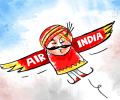
The Tata Group-owned Air India has readied a five-year transformation plan, which is expected to take its domestic market share to 30 per cent, up from 8.4 per cent logged in June. IndiGo leads with a market share of 58.8 per cent. The transformation plan--Vihaan.AI-unveiled on Thursday revolves around tripling the domestic market share with investments in new aircraft, technology and improvements in customer service.

Reliance Jio is close to finalising its contract with telecom gear maker Ericsson to roll out its 5G network in Mumbai and Maharashtra and Kolkata and West Bengal in the first phase of its launch in October. And it is going with Nokia for the lucrative Delhi circle, and Chennai, which includes Tamil Nadu, say sources aware of the development. This is the first time that Jio is opting for multiple vendors.

A few days ago, Reliance Retail surprised the market by acquiring the Campa brand from Delhi-based Pure Drinks Ltd for Rs 22 crore. A successful cola brand in the eighties, especially in North India, Campa Cola thrived when Coke exited India in the late seventies. When the Atlanta-based major returned and PepsiCo set base in India, it went down fighting.
 © 2026 Rediff.com - Advertise with us - Disclaimer - Privacy Policy - Sitemap - Feedback - About us - Terms of use - Grievances